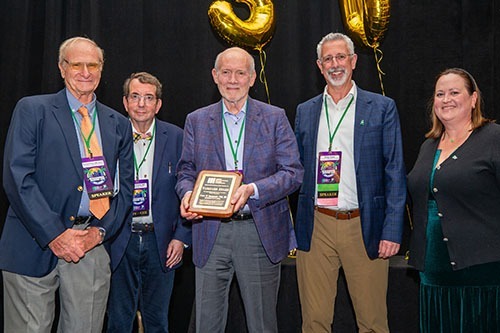
The Vanguard Award
The Vanguard Award
The UMDF Vanguard Award is presented to a scientist or physician in honor of his or her lifetime contributions to the field of mitochondrial medicine or research. The recipient is recognized for leadership and commitment towards a cure for mitochondrial diseases, whether through research or medical treatment, and whose inspiration has resulted in bringing new scientific or medical experts into the field.
This year, the UMDF and the Scientific and Medical Advisory Board are honored to present, in memoriam, for her incredible dedication to the fields of mitochondrial medicine and science to Dr. Lee-Jun Wong.
Remarks by Fernando Scaglia, MD – Baylor College of Medicine
I am truly honored to present In Memoriam the Vanguard Award to my dear mentor, colleague, and friend Dr. Lee-Jun C. Wong.
Dr. Wong was a Professor in the Department of Molecular and Human Genetics at Baylor College of Medicine (BCM), in Houston, Texas. She was born in Taipei, Taiwan, and received her undergraduate degree in Biochemistry from the National Taiwan University. She earned her PhD in Biochemistry from the Department of Chemistry at The Ohio State University under the mentorship of the National Academy of Sciences member Dr. Perry A. Frey. Dr Wong then did a post-doctoral fellowship with the Nobel Laureate Dr. Irwin Rose at the Institute for Cancer Research in Philadelphia, PA. That fellowship was followed by additional research training with Dr Bruce Alberts at Princeton University, and another fellowship with Dr. George Marzluf, back at The Ohio State University. She then took a faculty position in the Department of Biological Sciences at the University of Massachusetts-Lowell, where she earned tenure with her research while teaching and mentoring graduate students. After 14 years she made a career change and went to BCM to do a fellowship in Biochemical Genetics with Dr. William O’Brien. During that time, she also published with Dr. C. Thomas Caskey on the recently discovered triple repeat disorder Myotonic Dystrophy. Upon completion of her training, she took a faculty position as the Director of the Molecular Diagnostic Laboratory at the University of Southern California School of Medicine.
Dr. Wong’s interest in mitochondrial disorders began when she published papers on the then recently described MELAS and Kearns-Sayre syndromes. She pioneered techniques for the detection of mitochondrial DNA mutations, in addition to developing assays for prenatal testing of Mendelian disorders. In 1997 she became the Director of the Molecular Genetics Laboratory within the Institute for Molecular and Human Genetics at Georgetown University Medical Center. There she developed state of the art molecular diagnostic testing, and at the same time began a long-term research focus on the role of mitochondrial dysfunction in cancer. Her extensive number of publications focused on the widening molecular and clinical spectrum of mitochondrial disorders and other inborn errors of metabolism.
Dr. Wong returned to BCM in 2005, establishing and becoming the Director of the Mitochondrial Diagnostic Laboratory that she developed into a world-class diagnostic laboratory for mtDNA and Mendelian mitochondrial disorders. During this time, Dr Wong made seminal and ground-breaking contributions to the field of mitochondrial genetics. She developed the now gold standard diagnostic test for mtDNA using long range PCR and the pipeline for massively parallel next generation mtDNA sequencing, defining accomplishments of her extensive career. Furthermore, she developed algorithms for classification and interpretation of sequence variants linked to rare inherited mitochondrial disorders.
Over the years, she kept improving bioinformatic tools and computational criteria to validate novel disease-causing variants. Her scientific accomplishments and relentless enthusiasm led to the discovery of many novel variants and established their clinical relevance. The depth of her contributions on accurate clinical diagnostic testing and genetic counseling has had a significant impact on the classification of these genetically heterogeneous mitochondrial disorders and the lives of our patients with mitochondrial disease. She maintained an academic focus throughout her career, publishing over 400 peer-reviewed manuscripts on a broad range of topics, along with editing four books, while also directing a NIH-funded research laboratory focused on the role of mitochondria in cancer biology. Dr. Wong trained and mentored a large number of laboratory diagnosticians who now are Directors of diagnostic laboratories around the world.
She was an inspiration to many students, fellows, and faculty, to all of us, someone who always shared advice and laboratory tools unconditionally. With her incredible kindness, great vision, and sharp mind, she was always ready to enthusiastically discuss projects and new ideas at this meeting and so many other conferences. With great generosity she endowed the Shan and Lee Jun Wong Fellowship which is awarded competitively at Baylor College of Medicine to a trainee or early career faculty focused on translational studies in medical genetics.
Throughout her career, Dr. Wong has been a role model of integrity, leadership and mentorship. She has been an exemplary scientist and leader who passionately contributed to the field of mitochondrial disease. Dr. Wong was a valued member of our mitochondrial community and had an enormous impact on all of us through her innovative thinking, leadership, collaborative spirit, and dedication to mitochondrial diseases. Her contributions to science and medicine reflect her energy, enthusiasm, and deep knowledge of biology, and all her collaborators, mentees, and colleagues at her own institution, across the US and at an international scale have shared a heartfelt appreciation for her friendship, generosity, and sense of service. She is missed.
We are grateful that Dr. Wong’s daughter and son, Dr. Hansie Wong and Inyork Wong, will be accepting this award tonight on her behalf.
Previous Vanguard Awardees
Russell Saneto, DO 2024
Robert Naviaux, MD, PhD 2023
Bruce Cohen, MD 2019
Larry Grossman, PhD 2017
Richard Haas, MBChir, MD 2016
Douglas Wallace, PhD 2015
Chuck Hoppel, MD 2014
Salvatore DiMauro, MD 2013