
Just Released! Click here for our new TK2d Early Symptom Reflection Tool
Thymidine kinase 2 deficiency (TK2d) is a rare genetic mitochondrial disease that may also be called TK2-Related Mitochondrial DNA Maintenance Defect or Mitochondrial DNA Depletion Syndrome 2 (MTDPS2)[1]. As its other names suggest, TK2d is considered a Mitochondrial DNA Depletion/Deletions Syndrome (MDS or MDDS). It primarily impacts muscles.
Three main subtypes of TK2d have been described:
- Early onset begins before the age of 1-4 years. This subtype of TK2d rapidly progresses to death often in 1-2 years.
- Childhood-onset begins between the ages of 1 and 12. Most individuals with this subtype of TK2d survive more than 13 years after the first emergence of disease symptoms.
- Late-onset begins after 12 years of age. In general, individuals with this subtype of TK2d may be expected to live 23 years after disease onset.
Most reported cases of TK2d have been classified as either the early onset or childhood-onset subtype[2].
While estimating TK2d population size is challenging due to a number of factors, a 2023 publication put the disease’s prevalance at 1.64 patients per million people[5].

UCB has created “From One Caregiver to Another: A Shared Journey Through TK2D,” an interactive flipbook on TK2d for affected and caregivers.
- epilepsy
- heart problems
- kidney problems
- multiple bone fractures
- difficulty or inability to move the eye
- drooping eyelids
- respiratory difficulties
- hearing loss
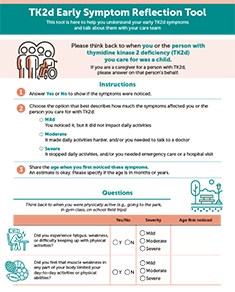
UMDF, in collaboration with UCB, has developed the TK2d Early Symptom Reflection Tool to help patients and caregivers prepare for meaningful conversations with their clinical care team. This tool is designed to prompt reflection on early symptoms and experiences that may be difficult to recall in the moment of an appointment.
Use it in whatever way works best for you – fill it out digitally and save it to your device, fill it out digitally and print it, or simply print it and write in your responses by hand. However you choose to complete, your answers can help guide a more informed, productive discussion with your clinician.
- molecular genetic testing for mutations in the TK2 gene
- blood tests for the creatine kinase enzyme
- a muscle biopsy
- brain-imaging such as a computed tomography (CT) scan or magnetic resonance imaging (MRI)
As of 11/3/25, the U.S. Food and Drug Administration (FDA) approved UCB’s Kygevvi (doxecitine and doxribtimine) to treat the mitochondrial disease thymidine kinase 2 deficiency (TK2d).
Other treatments that can address the manifestations of TK2d include:
- a gastrostomy tube for feeding difficulties
- chest physiotherapy
- non-invasive or invasive ventilator for respiratory problems
- physical and occupational therapy
- cane, walker or wheelchair for muscle weakness
- cochlear implants for hearing loss
- anti-epileptic medications for seizures
Since TK2d is an inherited disorder, genetic counseling for the family may also be recommended.
Are there any clinical trials for TK2d?
To see what trials you may qualify for, visit our Clinical Trials page – which also included a Clinical Trials Finder Tool. We also highly encourage you to join our patient registry, mitoSHARE, where we are actively recruiting TK2d families.
We are here to help. We suggest you reach out to our Support & Education Team – online, via email at support@umdf.org or phone at (888) 900-6486 – who can suggest a host of resources including doctors, disease specific support meetings, and more. They’ll also connect you with a UMDF ambassador, likely a fellow TK2d patient or family member, who can help support and guide you through your questions.
What are the next steps if my loved one has TK2d?
- Get Support
Connect with our Support & Education Team online, via email at support@umdf.org or phone at (888) 900-6486.
- Check our Clinical Trials Finder
Use our Clinical Trials Finder to see if you qualify for any clinical trials.
- Join our patient registry, mitoSHARE
We are actively recruiting TK2d families to participate in our patient registry, mitoSHARE. Patient registries like mitoSHARE are an integral part in charting a course toward treatments and cures for TK2d and other mitochondrial diseases. There are currently over 30 active mitochondrial disease clinical trials. Next generation patient registries like mitoSHARE are an integral part of expanding that number.
- Become an advocate
Ask your representatives to prioritize mitochondrial disease research and support via the UMDF Advocacy Center. We’ll send regular action items so you – and your friends and family – can let Congress know where we need their support. Click here to sign up.
- Join the conversation online
– UMDF Social Media Support Groups: Facebook Support Group
– UMDF News & Updates: Facebook | Twitter | Instagram | YouTube
- Get involved
Join the fight by giving your voice, generosity, time, or energy. Click here to see how you can help.
UMDF is helping chart a path toward treatments and eventual cure of mitochondrial diseases like TK2d through:
- Research & Funding: UMDF has provided more than $18 million in research funding to find treatments for diseases like MERRF. UMDF advocacy has helped secure an additional $80 million in federal funding via the Department of Defense’s Peer Reviewed Medical Research Program.
- Data: Over two decades ago, UMDF pioneered patient registries for the mitochondrial disease community. Today, our next generation patient registry, mitoSHARE, is helping chart a path toward the treatment and eventual cure of mitochondrial diseases.
- Patient Support: Thousands of families just like you depend upon UMDF for support and education on diseases like TK2d. Attendance at our support meetings annually tops 7,000, including disease specific support meetings for families.
- Clinician Support: To help educate clinicians on diseases like TK2d, we feature monthly Bench to Bedside clinician seminars, host the annual Mitochondrial Medicine Symposium, support the Mitochondrial Care Network, and educate clinicians on our Mito U platform.
- Advocacy: In January 2022, UMDF hosted a TK2d FDA Listening Session – in conjunction with MitoAction and TK2 Cures – featuring numerous FDA staff, four caregivers of affected youth, three adult patients, clinician Dr. Michio Hirano of Columbia University, and speakers from the advocacy groups.
- Surveys: Click here to view the “Voice of the Patient” TK2d survey results conducted in late 2021 / early 2022 as part of the TK2d FDA Listening Session.
- Masterclass: UMDF hosted the first-ever Mito Masterclass with a Focus on TK2d at Mitochondrial Medicine 2025 to train clinicians how to identify and treat patients. Click here to view CME for the course.
For more information on TK2d, please visit:
UMDF is here to help. Contact the Support Line at (888) 900-6486 weekdays from 8:00am to 5:00pm EST to connect with our Patient Concierge. Or, via email contact support@umdf.org.
- Wang J, El-Hattab AW, Wong LJC. TK2-Related Mitochondrial DNA Maintenance Defect, Myopathic Form. 2012 Dec 6 [Updated 2018 Jul 26]. In: Adam MP, Ardinger HH, Pagon RA, et al., editors. GeneReviews® [Internet]. Seattle (WA): University of Washington, Seattle; 1993-2022. https://www.ncbi.nlm.nih.gov/books/NBK114628/
- Garone C, Taylor RW, Nascimento A, et al. Retrospective natural history of thymidine kinase 2 deficiency. J Med Genet. 2018;55(8):515-521. doi:10.1136/jmedgenet-2017-105012
- Domínguez-González C, Madruga-Garrido M, Mavillard F, et al. Deoxynucleoside Therapy for Thymidine Kinase 2-Deficient Myopathy. Ann Neurol. 2019;86(2):293-303. doi:10.1002/ana.25506
- Berardo A, Dominguez-González C, Engelstad K, Hirano M. Advances in Thymidine Kinase 2 Deficiency: Clinical Aspects, Translational Progress, and Emerging Therapies. J Neuromuscul Dis. 2022;9:225-35. doi:10.3233/JND-210786
5. Yuanjun Ma, Lily Hines, Michael Agne, Chris Chinn. Prevalence estimation of thymidine kinase 2 deficiency, an ultra-rare autosomal recessive mitochondrial disease. ISPOR Europe 2023, Copenhagen, Denmark; 12–15 November 786213241-001_UCB_RAISE_Poster_1696mmX1200mm